godincidences – or, when things surprisingly work out…

godincidences – or, when things surprisingly work out…

This Lenten season, my church (Christ Church NYC United Methodist) has been partnering with Immigration Law and Justice of New York for a study called “Overcoming Fear Of The Other” where we’ve been using Bishop William Willimon’s book “Fear Of The Other” and Karen Gonzalez’s book “Beyond Welcome” as primary texts in studying “the other” framed in light of Christ’s ministry. We’ve talked about how people, especially immigrants, are put in the category of “other” and how that affects their treatment, especially during the political landscape we find ourselves in. It’s been a lot of good, thought-provoking discussions, and reading the books has opened up a new lens of looking at people and situations.

Last night, we were supposed to go to a community meal and Lenten service at our campus in Washington Heights. The service was a joint service with the Hispanic UMC congregations in the NYC area. I’d been really excited to go to it.

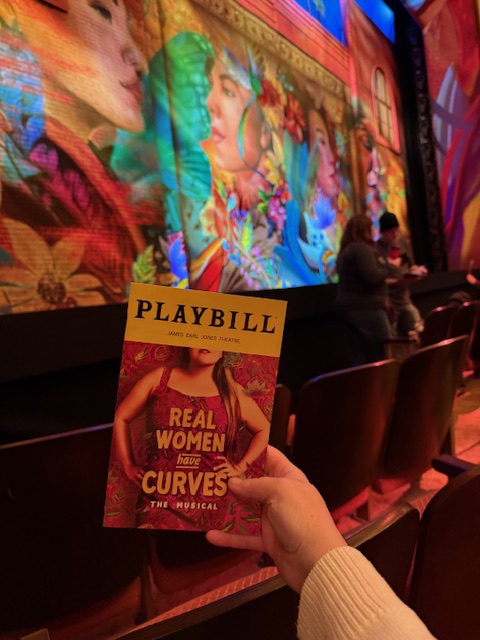
On Monday, I entered the ticket lottery for “Real Women Have Curves”, the new musical based on Josefina Lopez’s play and her HBO screenplay co-written with George LaVoo by the same name. I didn’t know a lot about the story besides having heard the title before – and I’d heard snippets of the music on Instagram, so I was really excited when I won a ticket in the lottery. (For those not familiar, it’s not a free ticket – just a severely discounted one. Sometimes they are “partial view” seats, but unless you get one of the behind the pole seats at “Hell’s Kitchen” they’re usually not bad.) For the majority of shows on Broadway that have lotteries, you enter the day before – so for entries on a Monday, it’s almost always for Tuesday night’s performance. I didn’t fully pay attention to the date, so when I got an email on Tuesday morning that was “in preparation for your show tomorrow night” I was confused. Until I looked at my e-ticket in my digital wallet.

Nope. It was for Wednesday night.

Which meant I needed to decide if I wanted to waste the ticket and go to the meal and service or use the ticket and skip the meal and service. While the lottery tickets are not that expensive, they are still money. And since I’m working on being better with my money, I decided to attend the show and sent my apologies to the pastor at our Washington Heights campus.

Well, I didn’t know walking into the show last night how it would dovetail so perfectly with the Lenten study it felt right that I was there. (Yes, if you’re familiar with the original play or the HBO movie, you are probably rolling your eyes and saying “Duh”, but remember I only knew the title – I’d never seen either before.) One of the underlying stories is immigration and undocumented persons – people who are very much “other”. A second is Ana’s struggle to reconcile her dreams and goals with the expectations placed on her by her family as she is the only American citizen in the family – so there’s a personal “othering” happening there as well.

There is joy woven throughout, even through the sad moments. One of the most joyful moments is during the titular song when the women – most of whom DO have curves – strip to their underwear in celebration of themselves, their bodies, and their lives. It’s in no way sexual or prurient. It’s full of self-acceptance from all the othering they face.

I am sorry that I missed the community meal and service, but attending “Real Women Have Curves” felt like an appropriate extension of the study we’ve been doing. Sometimes things that seem unrelated really end up being more related than we’d ever think.

And I know I can’t wait to go back to “Real Women Have Curves”. It’s worth it on so many levels.

an “incompatible issue” no more!

an “incompatible issue” no more!

In April of 1972, when I was around 9 months old, the General Conference of the United Methodist Church met and a paragraph was added to the Social Principles of the Book of Discipline (the Social Principles are meant as guidelines rather than law, but are often used as the latter) that affirmed “We declare our acceptance of homosexuals as persons of sacred worth and we welcome them into the fellowship of the church. Further we insist that society ensure their human and civil rights” and then in an amendment which was voted on by show of (and count of hands) this was added: “We do not condone the practice of homosexuality and consider it incompatible with Christian teaching.”

Incompatible with Christian teaching.

I may not have fully known and claimed who I was until much later, but for all intents the purposes, for all but my first 9 months of life, my church said I was “incompatible with Christian teaching.”

Then at the General Conference of the UMC in 2016, any discussion of changing the Social Principles or ANYTHING pertaining to the LGBTQIA+ community was pushed to the future and we were called “issues”.

But with the General Conference which has been meeting in Charlotte, NC since last Tuesday, to quote Dolly Parton, “I can see the light of a brand new morning”! Especially with what they did yesterday and today.

Yesterday they removed the ban on “self-avowed and practicing homosexuals” for ordination!!

And then today, after a LOT of debate and an amendment (with an amendment to the amendment), they revised the Social Principles and myself and my LGBTQIA+ siblings are no longer incompatible!!!!!

I got out of school in time to watch the final bit of debate and the vote, and when the Conference voted to remove the harmful language, I burst into tears on the sidewalk as I was walking home.

(The following is exceprted from my talk during the Price Service at Christ Church UMC New York from June 2023)

See, I was raised in the United Methodist Church, a preacher’s kid – who is also an out and proud lesbian. I didn’t always know that specifically – but I always knew I was different. As I got older and graduated from college, I became less and less comfortable in the United Methodist Church, largely because of what the Book of Discipline said I might not have had the words to identify myself as a lesbian yet, but I felt like I didn’t really fit.

I chose to go to the Episcopal Church and even worked in youth ministry in 2 Episcopal Churches before going to work at a United Methodist Church where it soon became apparent – when the Book of Discipline was thrown in my face the day after I had failed to condemn homosexuality during a vacation bible school lesson but instead had a lesson about inclusivity and acceptance after some of the kids chose to use the word gay as an insult – that they didn’t really want the kind of inclusive and safe for all youth ministry I brought and we parted ways. That experience pushed me first to discover my full identity as a lesbian and then right back to the Episcopal Church where I felt safer…or at least more welcome.

Looking back now, I don’t know if my moving to the Episcopal Church was that perhaps I might have started to sense some kind of calling but knowing I was different I knew I wouldn’t be accepted or not. I obviously can’t go back in time – and it’s a moot point now. If you’re over 40 it’s next to impossible to seek ordination since your available time before mandatory retirement would be short. But part of me wonders if that clause hadn’t been in the Social Principles if my life might have been very different.

I did see some positive things in parts of the United Methodist Church. I was introduced to Reconciling Ministries as my dad – who along with my mom has always fully accepted me – worked to lead his church through the process of becoming Reconciling. I saw pastors be brave enough to preside over a gay wedding, even knowing they could and likely would face charges and possibly defrockment. But I also knew the battles going on at General Conference. I heard myself and my LGBTQIA+ siblings called “issues” by some in that body. I sensed, as did many, that something would have to give – but I didn’t know what or when. 

It definitely felt safer to stay where I was, but deep down I felt not quite home, not quite where I belonged. I felt like safe wasn’t necessarily the right place for me. Then, while listening to Spotify one day while stuck at home during “Pause” (Governor Cuomo’s term for everyone staying home during COVID), some lyrics jumped out at me – lyrics penned by one of my longtime favorite United Methodist preacher’s kids who happens to be queer: Emily Saliers, one half of the Indigo Girls.

“But my life is more than a vision

The sweetest part is acting after making a decision

I started seeing the whole as a sum of its parts

My life is part of the global life

I’d found myself becoming more immobile

When I’d think a little girl in the world can’t do anything

If I have a care in the world I have a gift to bring

I gotta get out of bed and get a hammer and a nail

Learn how to use my hands not just my head

I think myself into jail

Now I know a refuge never grows

From a chin in a hand in a thoughtful pose

Gotta tend the earth if you want a rose”

Those words hit me hard. I realized that in going back to the Episcopal Church rather than remaining United Methodist, especially after my experience at the church where I’d briefly worked and knowing what that taught me about myself, I was running away. It was clear that a schism was imminent, and I was leaving the church that raised me – and leaving my LGBTQIA+ siblings – to fight while I watched from the sidelines. The more I prayed about it and thought about it, the more I knew what I needed to do – who I needed to become again.So in 2020 – in the midst of the pandemic – I made the prayerful and conscious choice to return home – to the United Methodist Church, and specifically Christ Church, to stand where I belong with all my queer siblings AND my United Methodist siblings. I’m finally back home to stay.

And as of today, I’m no longer an “incompatible issue”!!!

Thanks be to God!!